Thirty days, two keys on every payout, and no Withdraw button.
How I rebuilt Centient’s payouts for a Stellar Instawards grant, so every accepted answer pays the labeler’s wallet in USDC within seconds, signed by two keys, with no XLM of their own.
Sprint receipt · 7 Sep – 3 Oct 2026
114.85USDC
Paid on testnet to 61 wallets
- Deliverables
- 4 of 4
- Payouts
- 225
- Signatures on each
- 2 of 3
- XLM a labeler needs
- 0
- Unreconciled
- 0
- Status
- QA passed
Thirty days, four gates
Centient pays people to teach AI what “better” looks like. A task shows a question someone asked an AI and two answers to it. You pick the better one and say why in a sentence. Teams training models need thousands of those choices, and the people making them are often somewhere a bank transfer for a few cents makes no sense. So Centient pays in USDC on Stellar: dollars that settle in seconds, for a fraction of a cent.
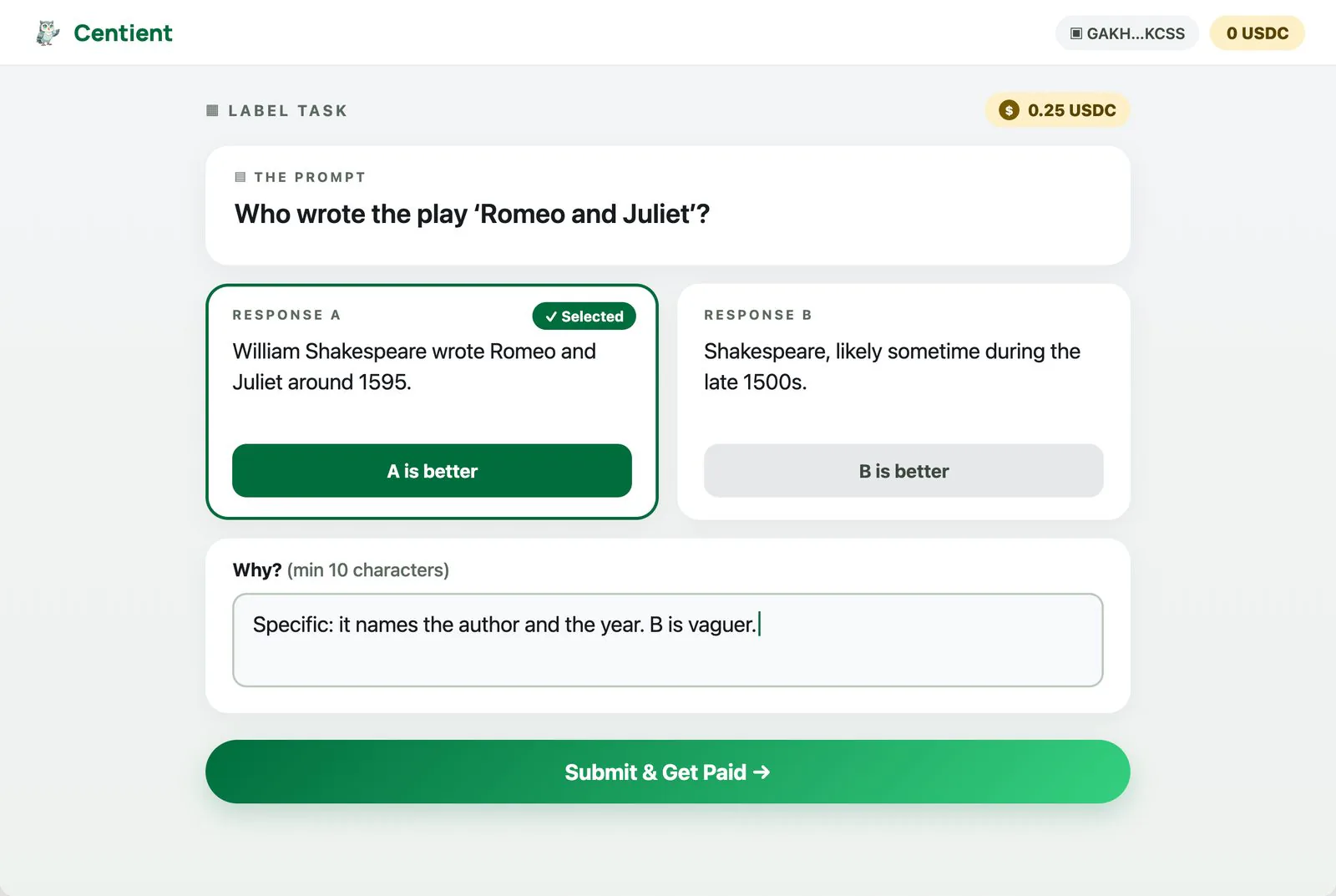
By September the labeling app worked, and its quality checks and reconciler were already live on Stellar testnet. What it didn’t have was a payout rail I’d trust with money. The Stellar Instawards program’s Philippines chapter, led by Nelson Lumbres, funded that part with a $5,000 grant: thirty days of full-time solo work, and four deliverables written into a statement of work before I started.
Every week ran the same way. Build Monday to Wednesday, one issue at a time. Freeze a build. Hand it to QA for a manual gate, and only then promote it. A gate never passes on code I’m still changing: it passes on one commit, and the approval is a comment with that commit’s hash.
Statement of work · four deliverables
- Reward railWeek 1 · gate passed 14 Sep
- 28 of 28
- Wallet sign-inWeek 2 · gate passed 21 Sep
- 38 of 40
- Pay per answerWeek 3 · gate passed 24 Sep
- 65 of 68
- Reconcile and releaseWeek 4 · gate passed 3 Oct
- 35 of 36
- Grant
- $5,000
- Days
- 30
- Status
- All four passed by 3 Oct
Two keys on every payout
The first week built the part a labeler never sees: the rail that sends the money. A payout system has one job it must never get wrong, which is to pay the right person the right amount, once. The easiest way to break that is one key that can pay anyone.
So no single key can. Centient’s payout account needs two signatures from three keys, and Stellar itself enforces that, not my code. The payout worker adds the first signature. The second comes from a co-signer: a separate service, deployed on its own, that can read the task ledger but not change it. Before it signs, it works the payout out again from scratch (the task, the amount, the wallet, the day’s cap) and refuses if anything doesn’t match.
One payout · 25 Sep 2026 · 06:03 UTC
0.25USDC
- To
- GAGK…5ET3
- Signature 1
- Centient’s payout key
- Signature 2
- The co-signer, after checking
- Network fee
- Paid by Centient
- Status
- Successful
Centient also pays the network fee on every payout, by wrapping it in a fee-bump, so the labeler gets the full amount. A cold reserve, which needs two of its own three keys, tops up the payout account only through transfers signed by two of those keys.
QA found one real problem that week, and it wasn’t in the code: the deployment kept two signing keys on one service, which is one point of failure with extra steps. The fix makes the payout service refuse any deployment that holds enough keys to pay alone, and CI fails the build if any code path could send a payout with fewer than two signatures. The gate re-ran and passed 28 of 28.
No XLM, no password
Most people who’d do these tasks have never held crypto. Two things usually stop them before the first one: an account to sign up for, and the rule that a new Stellar account must hold some XLM, Stellar’s own currency, before it can receive anything.
The second week removed both. There’s no email and no password. You connect Freighter, a Stellar wallet, and sign a one-time challenge that proves the wallet is yours. It expires, works once and is tied to that address, so it can’t be replayed. The wallet is the account, and the only place Centient will ever pay.
First connect · what you give
- None
- Password
- None
- XLM
- 0
- Signatures
- 1
- Account reserve
- Paid by Centient
- USDC trustline
- Paid by Centient
On first connect, Centient covers the reserves itself. It sponsors the new account and its USDC trustline, the opt-in a Stellar wallet needs before it can hold USDC, so the labeler signs once and spends nothing. Over the sprint, 105 wallets were set up this way, and 72 of them were brand-new accounts that started with 0 XLM. Centient keeps a record of every reserve it sponsors, with an audited way to reclaim them.
The Withdraw button went away
Until week three, Centient paid the way most apps do. Each accepted answer added to a balance, and once the balance passed 1 USDC you could withdraw it in one payment. In week two, the task reward went up to 0.25 USDC just so testers could reach that minimum.
Testers also told us it felt too good to be true. Five of the seven that week doubted they’d be paid at all, until they saw the money arrive. A balance is a promise. A payment is proof.
So week three made every accepted answer its own payment. When an answer passes the checks, its payout goes straight to the wallet, co-signed and fee-bumped like any other. There’s no balance to watch and no withdrawal step. Each payout is written to a journal under its own key before it’s sent, so a retry finds the first attempt instead of paying twice.
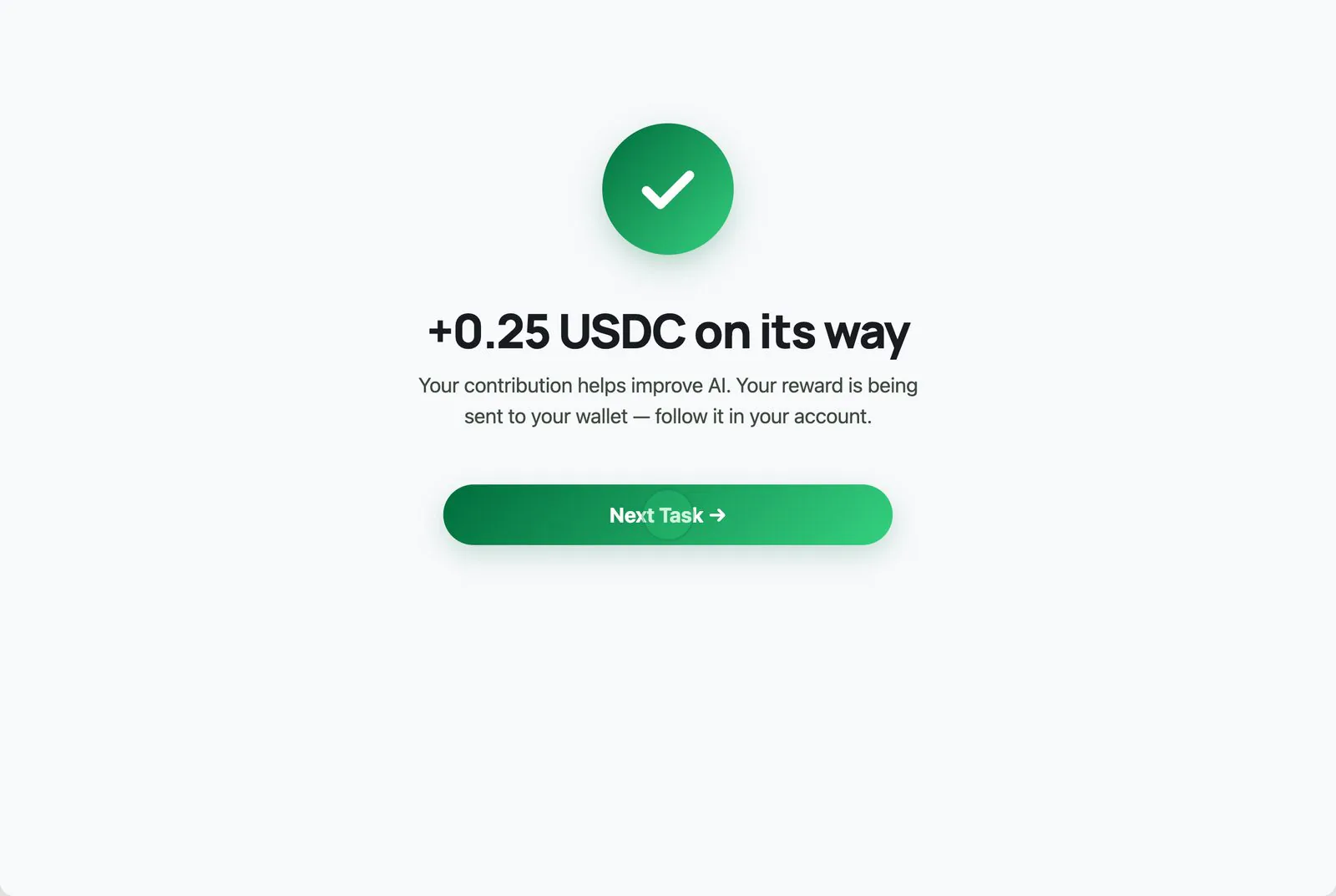
That left the old balances. On 21 September there were ten.
Balances waiting to be withdrawn · 21 Sep
- 2 over the 1 USDC minimum
- 8 under it, 1.60 USDC between them
Nothing would add to them again, so keeping the minimum would have stranded eight of the ten. The minimum went too. The old withdraw card now appears only for someone who still has a balance, and it pays out all of it. For everyone else, the Withdraw button is gone.
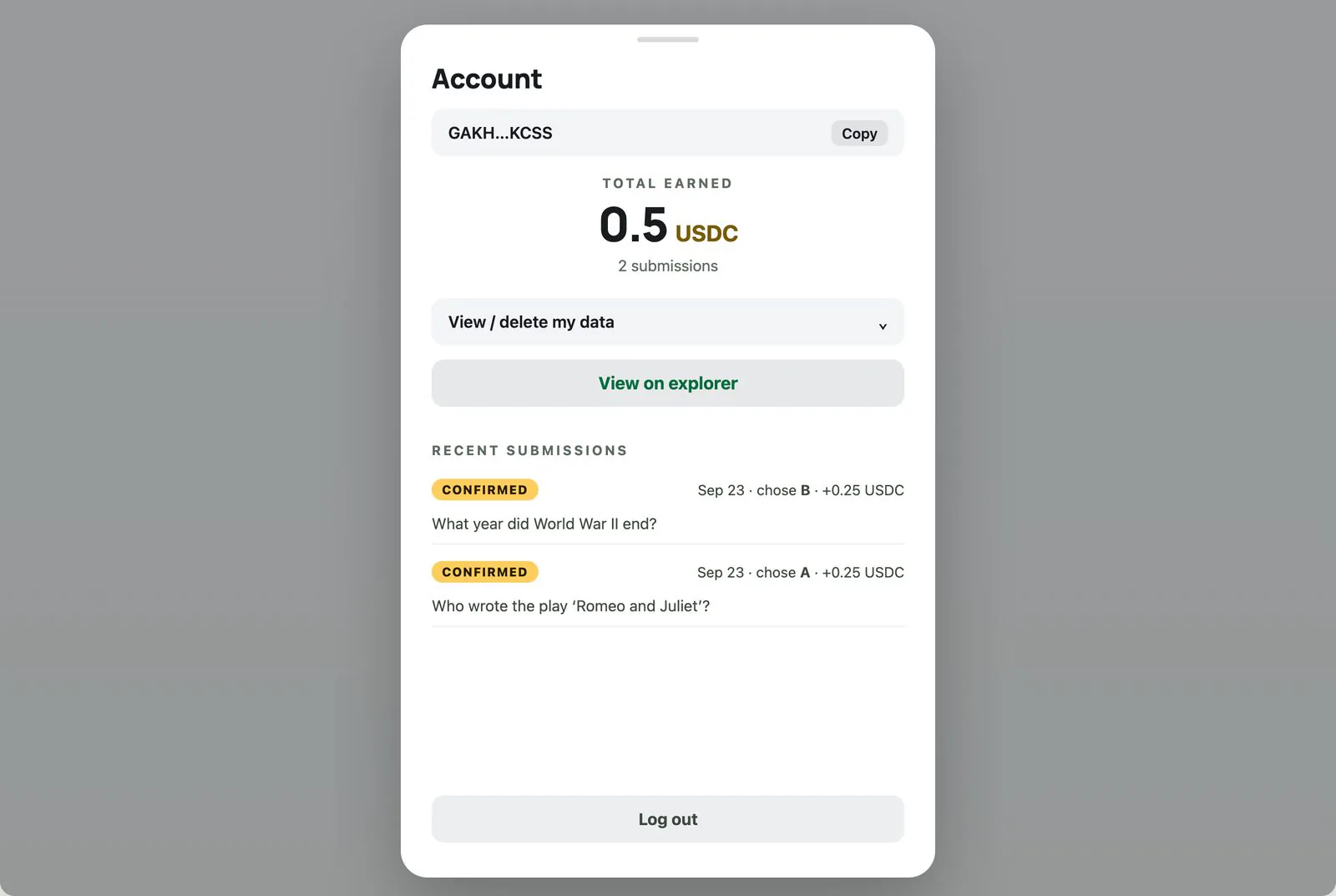
The gate passed a day early, on 24 September, and a reconcile run over the QA window matched all 70 payouts to the ledger. One tester that week: “Instant payouts straight to the wallet are a big improvement.”
| Week | Payouts | USDC | Wallets | How it paid |
|---|---|---|---|---|
| 1 | 13 | 22.01 | 3 | Earn, then withdraw |
| 2 | 34 | 49.81 | 14 | Withdraw at 1 USDC |
| 3 | 127 | 37.70 | 28 | 0.25 for each answer |
| 4 | 51 | 5.33 | 24 | 0.01 for each answer |
| All | 225 | 114.85 | 61 |
Proof in public
The last week was about showing the rail holds up when things go wrong, to people who can check. First, four failures, caused on purpose.
Failures, caused on purpose · 4 of 4 held
- Two payouts race for one sequence number. One lands, the other retries. Nobody is paid twice.
- The co-signer goes down. Payouts wait, an alert goes out, and they resume when it’s back.
- The daily cap is passed by one unit. Both signers refuse it.
- Horizon times out mid-payment. Settled only from proof on the ledger, never by guessing.
The suite earned its keep: it caught a real bug, a fee-bump built on a stale sequence number, fixed before the gate.
Then volume. The statement of work asked for at least 100 reconciled payouts to at least 25 wallets. The proof run reconciled 122 payouts to 25 wallets, with none missing and none paid twice. Over the whole sprint, the payout account sent 225 payouts to 61 wallets, every one signed by two keys, fee-bumped and successful on the ledger.
USDC payouts per day · Stellar testnet
Anyone can check, because every payout is a public transaction on Stellar testnet. The build went public too, with its runbooks, the payout API docs and a docs site, and the live app shows which commit it’s running. The last gate passed on 3 October, day 27 of 30.
Twelve phones at a booth
Week two’s testers were all on laptops, because Freighter couldn’t sign in from a phone yet. Week three connected Freighter Mobile over WalletConnect, and phones went from 2% of page views to over half by week four.
Phones’ share of page views
- Week 22%
- Week 346%
- Week 452%
In week four, a walk-up booth put it to the test. Twelve people who’d never used Centient connected a wallet on their own phones, ranked answers and were paid. All twelve finished, and seven said there was no step where they’d have given up.
What changed most over the month was trust, and it wasn’t anything we said that changed it. It was the payment arriving. As a week three tester put it: “I could see the payments arriving in the wallet in real time.” Of the 28 testers who left full evidence over three weeks, none reported a missing payment, and every payout a tester claimed is on the ledger.
Try it
Centient is live on Stellar testnet. Connect Freighter set to Test Net, rank a few answers, and each accepted one pays your wallet. Mainnet was left out of this sprint on purpose, and the payout service still refuses to sign there.